The Economist's 2027 Cover Is Red, Black and Crowded. Its Biggest Economic Warning Is About Debt.
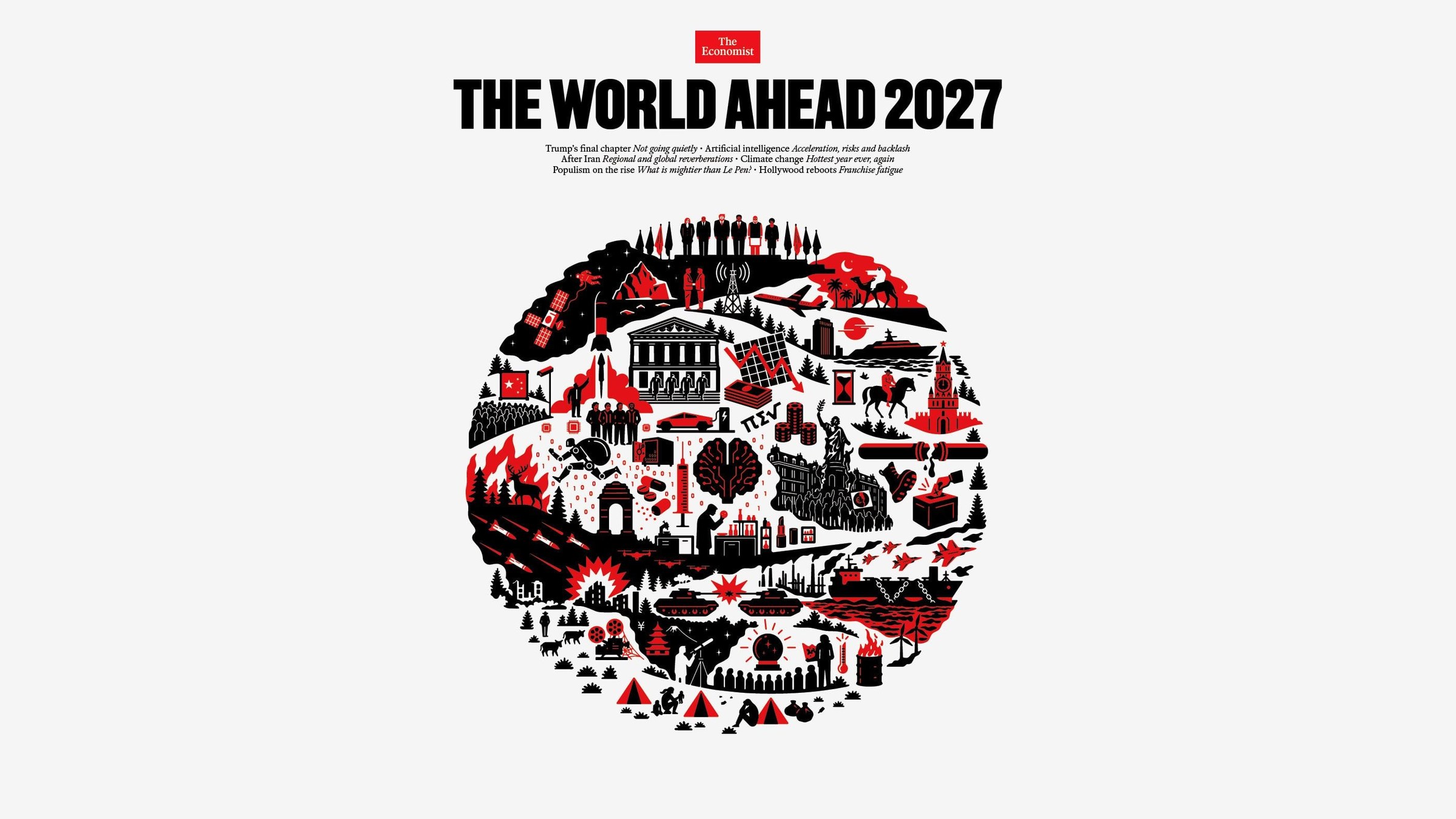
If The Economist is right, 2027 is the year debt bites: dearer mortgages and loans, and food prices up about 7% again.
- On 16 November 2026 The Economist released the cover of The World Ahead 2027, its yearly forecast issue. The art, by American artist Cleon Peterson, is a red, black and white circle full of small scenes: tanks, a chained ship, a robot, a falling chart, a ballot box, a burning barrel, a rocket and a crystal ball.
- Six lines sit on the cover: Trump's final chapter ('Not going quietly'), artificial intelligence, after Iran, climate change ('Hottest year ever, again'), populism ('What is mightier than Le Pen?') and Hollywood reboots.
- Inside, editor Tom Standage lists ten trends. Four are about money: AI companies taking on 'complex and opaque' debt, rising government borrowing costs in rich countries, France's debt and its 2027 election, and fertiliser and food shortages from the Iran war.
- His verdict on debt: 'Something, somewhere will have to give.'
- A different '2027 cover' went viral in September. It was fake, made with AI. The real one is the 16 November cover.
What does the 2027 cover actually say?
It is a drawing of many small scenes about war, AI, money, climate and politics. Six short headlines name the big themes. It is a summary of trends, not a secret code.
ConfirmedWhy does The Economist worry about AI money?
AI companies are borrowing huge sums to build data centres. If the profits come late, that debt could cause a sharp fall in markets.

Why are borrowing costs and France on the list?
Rich governments owe more and more, and lenders want higher interest. France is the weak spot: big debt and an election in spring 2027 where Marine Le Pen's party could win.
What does it mean for food prices?
The Iran war cut fertiliser supplies through Hormuz. Less fertiliser now means smaller harvests later, so food may get dearer again in 2027.
What does the 2027 cover actually say?
The World Ahead 2027 cover was released on Monday 16 November 2026 (S Ziņas; Common Sense Desk says 16-17 November) and is drawn by American artist Cleon Peterson in stark red, black and white. Common Sense Desk describes a big circle packed with scenes: leaders and a tower marked 'TRUMP', tanks, missiles and warplanes, an oil tanker in chains, tents and displaced people, a Chinese flag over a crowd watched by a camera, the Kremlin's Spasskaya Tower, a robot and a circuit-board brain, a red arrow falling across a grid with cash and poker chips, a ballot being dropped near what looks like France's Marianne, forest fires and a burning barrel, a rocket and satellite, a film projector and a crystal ball. The six cover lines are: 'Trump's final chapter: Not going quietly'; 'Artificial intelligence: Acceleration, risks and backlash'; 'After Iran: Regional and global reverberations'; 'Climate change: Hottest year ever, again'; 'Populism on the rise: What is mightier than Le Pen?'; 'Hollywood reboots: Franchise fatigue'. Editor Tom Standage's ten trends add Taiwan, government borrowing costs, weight-loss drugs and cheaper space launches. His opening line, per Wealth Adviser: 'The post-Trump era is beginning. But don't expect the president to go quietly.' Beware the fake: in September, AAP FactCheck confirmed with The Economist that a viral 'The world in 2027' cover, dated 4-10 January 2027, was AI-generated. Reading the cover as a coded plan for war is commentary, not anything The Economist says (S Ziņas, Merca2.0).
ConfirmedWhy does The Economist worry about AI money?
The Economist's AI trend is called a backlash, but its economic core is debt. Wealth Adviser quotes the issue: 'The risk of a breakdown will rise as AI companies take on more debt in complex and opaque deals.' Common Sense Desk reports the same warning of 'a sharp market correction'. Kursiv adds numbers from other sources: Goldman Sachs Research expects the biggest cloud companies to issue $420bn of debt in 2027, up from about $250bn in 2026, and the IMF names an AI sell-off as a risk that could tighten credit. The same issue says fears about AI jobs and data-centre water and power use are 'about imagined impacts, not real ones' (Wealth Adviser). Rated 'uncertain': the debt is real and growing, but no source gives a date or trigger for a fall, and a forecast of a bubble is not a bubble bursting.
Why are borrowing costs and France on the list?
The Economist names three forces pushing up government borrowing costs across rich countries: 'Fiscal irresponsibility, the AI-driven construction boom, and the resurgence of inflation' (quoted by Wealth Adviser), the inflation coming from higher energy prices after the Iran war. Its conclusion: 'Something, somewhere will have to give.' Common Sense Desk quotes the issue saying heavy spending and higher borrowing costs 'could threaten financial stability in several countries'. France is the named example. It votes for a president in spring 2027 (Kursiv), and the cover asks 'What is mightier than Le Pen?'. Wealth Adviser quotes the warning that a National Rally win 'could derail the Franco-German engine that drives the European Union' and worry markets about France's debt-laden finances. Kursiv cites the IMF forecasting French public debt at about 120% of GDP in 2027 and Fitch's downgrade of France for slowing growth, higher borrowing costs and a growing deficit. Rated 'likely' for the pressure itself (the debt figures are published), not for any crisis: the election result is unknown.
What does it mean for food prices?
The Economist expects the Iran war's effects to last through 2027, reshaping energy flows and threatening food security through fertiliser shortages (Türkiye Today, Wealth Adviser, UA.NEWS). Kursiv links this to disruption in the Strait of Hormuz, a key route for fertiliser, and cites the FAO warning that late fertiliser deliveries can mean smaller harvests months later. It also cites the World Bank's 28 October 2026 outlook: global food commodity prices up about 7% in 2027, after an estimated 10% rise in 2026. A 'super El Niño' adds to the risk; the issue expects 2027 to be the hottest year on record again (Wealth Adviser), and US forecasters expect El Niño to stay strong through early 2027 (Kursiv). Rated 'likely' because the World Bank number is a published forecast, but weather and the war's course can still move it either way.
Domino Effect
The causal chain so far, dated from what the sources actually report. New dominoes append as they fall.
The World Ahead is a list of trends, not a prophecy. Tom Standage has said that when the 2022 issue went to press, 'we didn't think Russia was going to invade Ukraine'. The 2027 debt warnings could fade if inflation cools and central banks cut rates, and AI profits could arrive fast enough to carry the borrowing. The biggest shock of 2027 may be one no cover shows.
Corrections & revisions
noneEvery change to this analysis since publication, with the reason. We append here — we don't rewrite. A number that changes silently is indistinguishable from never having been wrong.
RSS feed- No corrections yet. When we get something wrong, the fix is logged here rather than quietly applied.
Sources
9 sources
Every source behind the Trust Index above. Follow them — a trust score you can't check is decoration.
- The Economist's 2027 cover: what the pictures really mean
- The Economist unveils its World Ahead 2027 cover: what the magazine expects next year
- The World Ahead: The Economist Names the Top 10 Trends for 2027
- Costly food, AI bust, Taiwan and other shocks the world should fear in 2027
- A new war in 2027? The Economist flags 10 trends shaping the year
- The Economist's 2027 Cover Explained, What Its Images of War, AI and the Economy Mean, According to the Editor's 10 Key Trends
- Opaque Deals and Cyberattacks: The Economist Predicts a Rise in AI Risks in 2027
- The Economist unveiled the cover of its 2027 forecast on the post-Trump era and the threat of war over Taiwan
- Fake Economist cover spreads on social media
Nothing here stands alone. This story is one node in a wider web — every card is another thread you can pull.